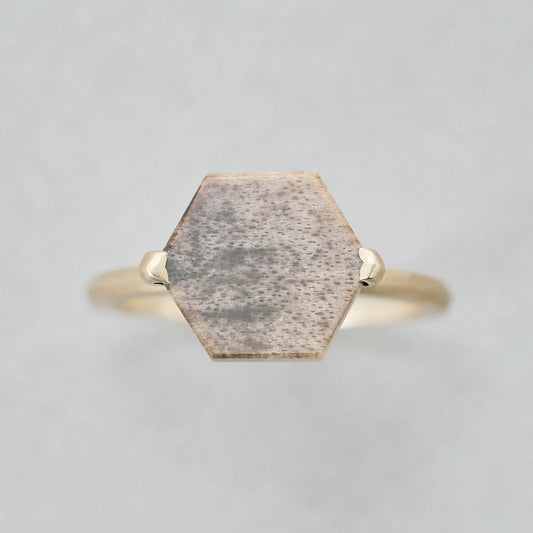
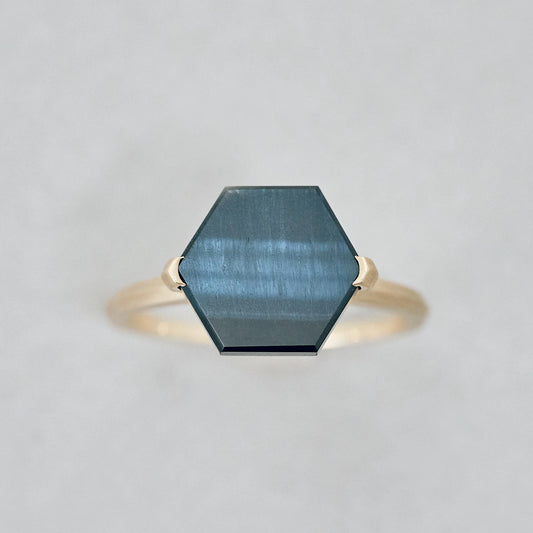
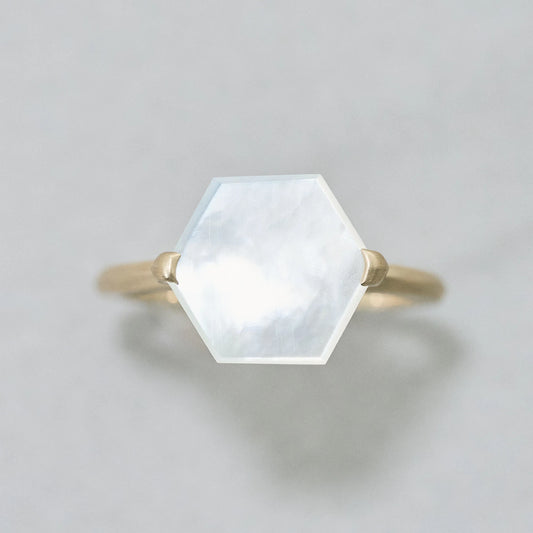
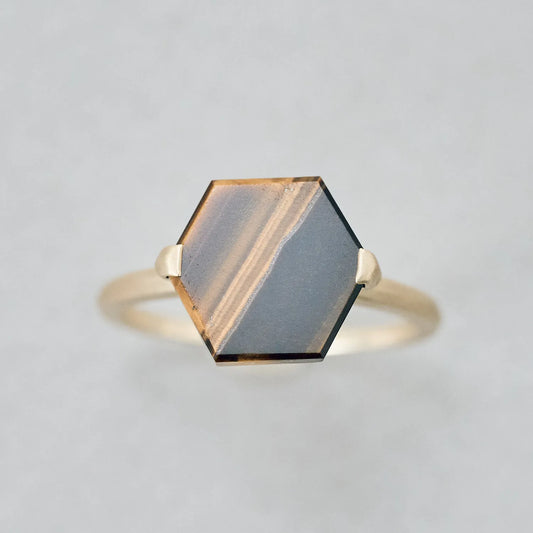
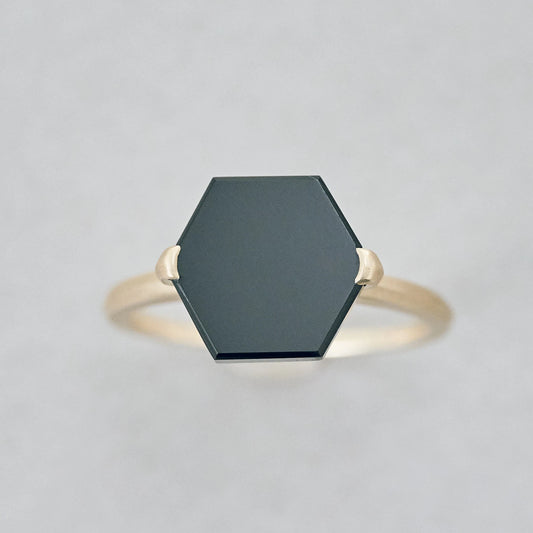
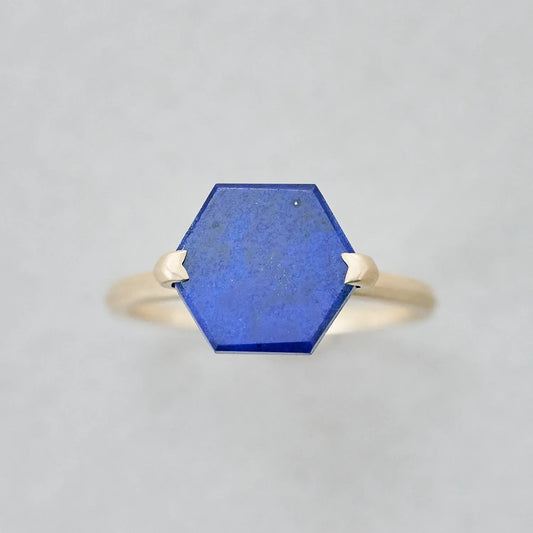
How few elements are needed for a form to hold together?
The "Node" collection began with that question.
In jewelry, stone setting comes with a kind of "common sense." With prong settings, for example, the stone is supported by four or six prongs. By fixing it at multiple points, stable strength is ensured. It is a rational method that has long been used.
On the other hand, the more prongs you add, the greater the impact on the design. Even when the focus should be on the stone, the elements used to support it start entering the viewer's line of sight.
We wanted to support it with as few elements as possible. But we did not want to compromise strength. Achieving both was the starting point for this collection.
Two prongs and a V-shaped groove

In Node, we have narrowed the number of prongs down to two. Of course, simply reducing the number is not enough to support the stone stably. So we adopted a structure with a V-shaped groove on the inside of each prong.
As the faceted edges sit in that groove, the contact area increases, creating a structure in which the stone is supported across multiple surfaces. It appears to be supported at two points, while internally it is held by several surfaces.
Even with the elements kept to a minimum, it holds together. That balance shapes the framework of this jewelry.

Reading the expression within the stone

Another important aspect is how the stone itself is handled.
The hexagonal natural stones used in this collection have a uniformly geometric outer shape. But inside each one, there are distinct patterns and flows of color.
Which face should be cut as the stone's "face"?
In which direction should the pattern run?
Depending on that choice, an entirely different expression can emerge, even from the same rough stone.

From our position as designers, we put into words the expression we want and convey it to the craftspeople. But the final decision on where to cut it is left to them.
Holding the stone and checking how the light falls on it, the craftspeople search for the position where its appeal comes most vividly to life. This "stone selection" process greatly influences the final impression.
Structure and material, in balance

Structure and material: neither can stand on its own. Only when the two are in balance does it truly work.
The name "Node" carries the meaning of a point where forces gather and form takes shape. A stone supported by the most minimal structure quietly brings out the expression held within it.
This is a collection designed to hold that balance at your fingertips.